
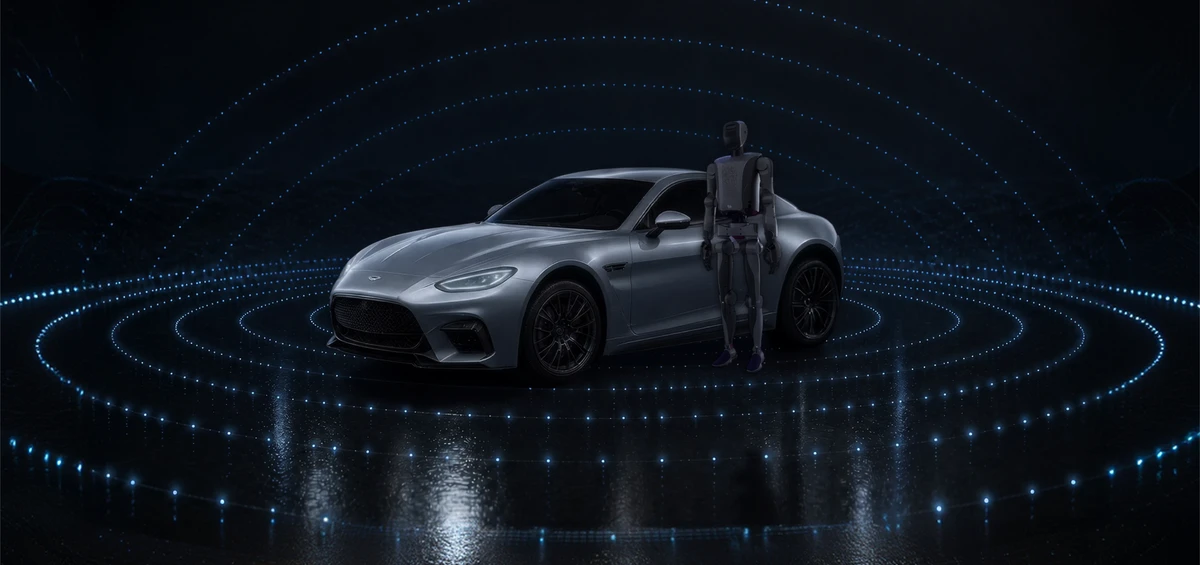

Autonomous driving has always required AI to understand the world, make decisions, and act safely in real time. But with the rise of robotics and Mobileye’s own Mentee humanoid robot, Physical AI is entering a new stage. Here, we explore what Physical AI is, what it can do, and Mobileye's distinctive approach to realizing one of the most impactful embodiments of AI systems.
What is Physical AI?
Physical AI is a mode of artificial intelligence designed to understand context, infer intent, and interact naturally with humans in the real world. Several forms of artificial intelligence exist today. Generative AI can create text, images, code, and other forms of digital content, while agentic AI can pursue tasks using digital tools. As these technologies continue to evolve, the newest, and potentially most impactful, manifestation is Physical AI.
What are the different forms of physical AI?
Physical AI can take many forms. At Mobileye, the focus is centered around both autonomous vehicles and humanoid robotics.
In the AV sphere, robotaxis and consumer AVs are designed to be capable of perceiving, reasoning, and driving completely autonomously.
Humanoid robots are another form of Physical AI, supporting a wide range of use cases. These include industrial humanoids designed for factory floors and manufacturing environments, as well as humanoids with the level of dexterity needed for the home, such as the finger mobility required to pick up a cup of coffee and place it back on a table.
Whatever the form, Physical AI must continuously interpret real-world environments, predict the behavior of those around it, and work safely alongside people.
In the case of autonomous vehicles, this means understanding the road environment, human driving, and being designed to drive safely. For humanoids, it means navigating dynamic spaces and, of course, being built to interact safely with humans.
Why do we need Physical AI?
For autonomous vehicles, adoption and demand have continued to grow over time. The potential for AVs to make roads safer, improve mobility, and increase access to transportation has long been established. Even highly capable driver assistance systems powered by advanced AI have been associated with improvements in safety and driving performance.
The rise of humanoids has unlocked a new generation of use cases. Physical AI can support work in warehouses, industrial settings, and other physically demanding environments. It can help make repetitive or strenuous tasks safer and more efficient.
The Mobileye approach to Physical AI
Mobileye's approach to Physical AI is founded on four core principles that equip autonomous vehicles and humanoid robots to make intelligent decisions in complex, dynamic, real-world environments.
The four principles:
Safety by architecture
Redundancy is a cornerstone of Mobileye's approach, with key technologies embedded across hardware, software, and AI processes. For automotive applications, foundational to this architecture is RSS (Responsibility-Sensitive Safety), a published framework that defines safe driving behavior and helps ensure vehicle decisions remain within verifiable safety boundaries.
Complementing RSS is a rigorous safety methodology designed to systematically identify, validate, and address potential system failures, supporting safe, explainable driving behavior. At Mobileye, the focus is on building systems that are not only intelligent, but also rigorously validated and designed for safe, real-world deployment.
Edge-case-led learning
Through Meteor, Mobileye's multi-agent AI data analyst for autonomous driving, rare but reproducible driving scenarios can be systematically identified and analyzed to uncover recurring system weaknesses. Genario, a targeted scenario simulator, designed to systematically tackle the long tail problem, then generates targeted synthetic training scenarios based on those findings, their root cause, and the conditions that trigger it. Together, they are designed to help autonomous driving systems improve performance across the long tail of meaningful edge cases.
Purpose-built stack
Across Mobileye's ADAS and AV stack, each layer is designed to perform its role independently through a combination of advanced learning, purpose-built components, and system-level logic across perception, planning, decision-making, and control. Rather than relying on a monolithic, general-purpose AI, Compound AI takes a modular, layered approach. Each component is optimized for a specific sub-task, and the system coordinates their outputs to produce a cohesive, intelligent result. Rather than having each capability developed independently, Mentee's humanoid is purpose-built as a single integrated system. Its fully back-drivable hands with native haptic feedback support human-compatible manipulation, optimized by the tight integration of its hardware and software across perception, navigation, language understanding, learning, and physical interaction.
Scale-first engineering
When it comes to scalability, performance is only part of the equation. Compute efficiency, cost, system design, and manufacturability all shape whether an AI system can move beyond research and into real-world use. At Mobileye, these considerations are part of the engineering process, with decisions shaped not only by what a system can do, but by how it can eventually be produced and deployed at scale.
The way this takes shape differs across domains. In automotive, it can mean optimizing hardware, software, and compute around the constraints of mass production. In humanoid robotics, vertical integration brings hardware and software development closer together, allowing the system to be iterated, trained, and optimized as a whole.
What learning methods does Physical AI require?
Learning methods vary across different types of Physical AI.
Technologies such as Meteor generate diverse, safety-critical scenarios beyond those encountered in everyday driving, while Genario-powered simulation and real-world validation are designed to enhance robustness, generalization, and safety before deployment.
For humanoid applications, training relies on different approaches. Techniques such as few-shot learning allow for new tasks to be learned by observing only a small number of demonstrations. The Mentee humanoid learns through mentorship, acquiring new capabilities after a number of demonstrations.
Approaches such as Real2Sim2Real further enable AI systems to transfer learning efficiently between simulated and physical environments, with the potential to reduce training time while supporting real-world performance.
What is the future of physical AI?
Physical AI is a fast-evolving field with the potential to take technology to entirely new heights. While the future is uncertain, its trajectory will likely depend on two factors: quality and scalability. As perception, reasoning, and action continue to evolve together, these systems may become safer, more capable, and even more useful alongside people. But for Physical AI to make a real-world impact, scalability is essential.
From software and hardware development to manufacturability, bringing these technologies to scale will determine how widely they can be deployed. These are the same engineering principles that have shaped Mobileye's approach to autonomous driving and are now helping inform its work in Physical AI.


