
blog
|
December 31, 2025
The shift towards centralized intelligence
In this current landscape, the challenge isn’t just updating software, it’s ensuring that safety-critical driving functions remain uncompromised.


Software embedded in vehicle platforms, which has grown over time to exceed 100 million lines of code.
As the industry consolidates compute, and looks to enable a software-defined experience, the challenge isn’t just updating software, it’s ensuring that safety-critical driving functions remain uncompromised. Today, software capabilities increasingly define a vehicle’s appeal, enabling new features and revenue opportunities long after it leaves the factory floor.
This evolution is evident in the steady expansion of software embedded in vehicle platforms, which has grown over time to exceed 100 million lines of code in many modern vehicles. Supporting and enabling this code-based growth requires a new generation of hardware: powerful, system-on-chip (SoC) domain-level processors capable of advanced computing, AI processes, and cloud connectivity. These computer systems enable vehicles to evolve over time, execute complex safety functions, and power in-cabin applications without compromising performance or reliability.
Such progress demands deep expertise, the ability to deliver the high-compute and safety foundations that can enable automakers to consolidate control, simplify complexity, and scale confidently toward their next generation of intelligent vehicles.
Why do automakers race toward ECU consolidation?
For decades, vehicles relied on a patchwork of electronic control units (ECUs), often more than a hundred per car, each managing separate functions from multiple suppliers. This created a system that was costly, complex, and difficult to update. The industry’s answer to the growing complexity has been consolidation, and the creation of a system in which fewer, more capable domain controllers become linked through high-bandwidth gateways to enable cross-domain functionality.
This consolidation re-centers the vehicle around powerful system-on-chips that can host multiple software functions and domain workloads in one place. It simplifies software management across models and the vehicle lifespan. And with flexible hardware and over-the-air updates, automakers can roll out new features, improve performance, and introduce subscription-based services long after production.
The shift is also redefining competition across the supply chain, as chipmakers and software providers race to build reliable, safety-ready platforms for a rapidly digitizing vehicle fleet. In this current landscape, architectures that combine high computing performance with validated safety separation will likely define how effectively automakers can pursue their software-driven goals at scale.
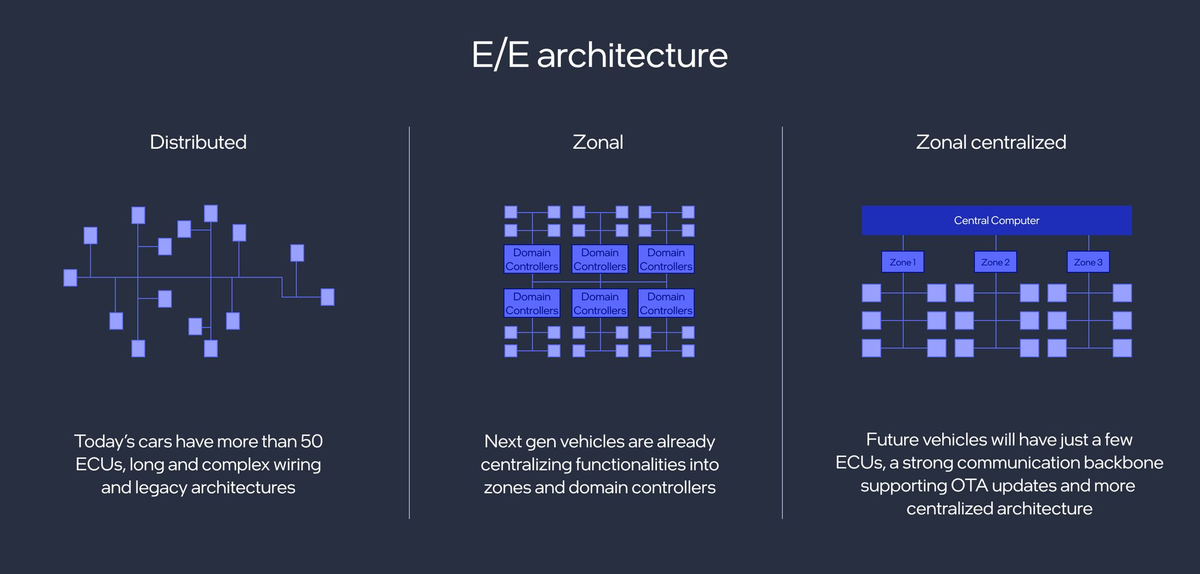
Consolidating E/E (electrical/electronic) architectures in cars has limitations
Compute consolidation comes with new challenges, with the boundary becoming blurred between safety-critical systems and non-safety applications. Competing architectures that merge everything into one platform risk bottlenecks and validation gaps, as well as the possibility that a post-production software update unintentionally impacts braking, perception, or other essential safety functions.
There is more than one way to architect centralized vehicle compute. Mobileye takes a path that combines consolidation with separation, connecting our EyeQ™ SoCs through a Multi-Domain Controller (MDC) architecture that is designed to keep safety-critical driving functions distinct from general-purpose workloads. This is designed to ensure that driving decisions remain validated and deterministic, even as new software features, via over-the-air updates, are introduced to the rest of the system.
Built for holistic integration, Mobileye’s system is designed to support applications, and cloud connectivity, all while preserving safety critical ADAS.
How do automakers preserve validated safety as new software layers keep evolving?
Every automaker is responsible for the safety of its vehicles at the moment of release. The challenge begins the moment software starts to change. As new features, updates, and applications are added over the vehicle’s lifespan, the original validation that provides safe performance can be unintentionally altered. Ultimately, it comes down to creating a system that enables freedom from interference, in other words, ensuring that safety-critical tasks are not compromised as software evolves.
Validated safety must remain intact, regardless of how many new software layers enter the system. It can’t depend on shared compute or unpredictable resource competition. That’s why Mobileye’s architecture enforces strict isolation between safety-critical driving functions and all other vehicle domains. This separation is designed to ensure that essential ADAS or autonomous-driving tasks stay fully validated and behave consistently even as the surrounding software evolves.
Mobileye’s approach is open where it matters and isolated where it must be. This is seen in Mobileye’s DXP, where automakers can integrate their own middleware, OTA systems, and user-facing applications while relying on Mobileye’s proven foundation to protect the vehicle’s ability to see, decide, and act safely in every condition.
The future is safe and autonomous
By combining validated driving intelligence with flexible integration, Mobileye gives automakers the confidence to scale their digital ambitions without ever compromising what matters most on the road. The industry is evolving toward more connected, intelligent, and autonomous vehicles, and Mobileye is ensuring that safety evolves with it. In the future, autonomy won’t just be intelligent. It will be safety-defined.
Share article
Related News

Press Contacts
Contact our PR team


