
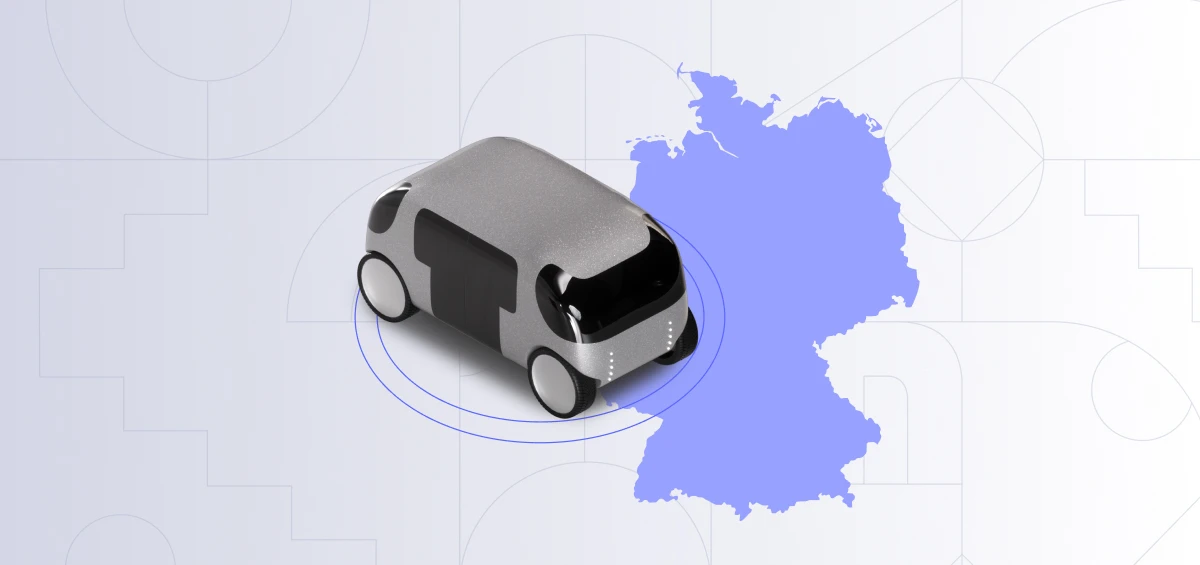

The majority of all vehicles holding valid L4 testing permits in Germany include Mobileye Drive™
Germany has firmly established itself as a premier global market for autonomous vehicle innovation with Mobileye Drive™ at the forefront of current testing.
Germany has established a rigorous regulatory environment for autonomous vehicle development and testing, with a structured permitting process for vehicles operating on public roads. This framework has made Germany an important market for advancing autonomous mobility from development toward real-world deployment.
Official data published this August (2026) by the Kraftfahrt-Bundesamt (KBA), Germany’s Federal Motor Transport Authority, provides a snapshot of Level 4 testing activity across the country. An evaluation of valid Level 4 testing permits in Germany shows that vehicles incorporating Mobileye Drive account for more than 60 percent of all vehicles currently authorized for Level 4 testing.
In a competitive technology marketplace featuring numerous global automated driving system developers, this data reflects the significant presence of Mobileye Drive across Germany’s Level 4 testing landscape.
What does a Level 4 permit signify under modern automotive standards?
A Level 4 automated driving system is engineered to perform the complete dynamic driving task within a specified Operational Design Domain (ODD) without requiring a human driver to take control. Reaching the threshold where a vehicle can safely navigate mixed urban traffic, complex intersections, and unpredictable pedestrian behavior demands a firm commitment to system safety and functional reliability.
The KBA data shows that vehicles incorporating Mobileye Drive represent more than 60 percent of the vehicles currently authorized for Level 4 testing in Germany. These vehicles span three distinct vehicle platforms rather than a single specialized vehicle model. This multi-platform representation highlights the adaptability of Mobileye Drive and demonstrates how the underlying self-driving system is being integrated across diverse vehicle architectures and autonomous mobility programs. The KBA data confirms that Mobileye Drive accounts for more than 60 percent of all valid Level 4 permits assessed in Germany. Crucially, these approved permits encompass three distinct vehicle platforms rather than a single specialized vehicle model.
Driving intelligence built for no-driver mobility
Mobileye Drive is designed as a commercial-grade automated driving system tailored for autonomous mobility-as-a-service. These range from high-occupancy ride-pooling to fixed-route urban shuttles and on-demand public transit. Mobileye Drive is the L4 Self-Driving System containing the software and hardware stack designed to enable these services within its ODD, without a human driver. Rather than restricting mobility operators to a single vehicle model, Mobileye offers an adaptable system that is designed to enable vehicle manufacturers and transit providers to commercialize driverless fleets efficiently.
At the core of this adaptability is Mobileye’s driving intelligence. Mobileye Drive applies Mobileye’s Physical AI approach to no driver mobility. Among other things, AI is used to support driving decisions and help the vehicle understand its surroundings. Mobileye combines AI-driven perception with decision-making and technologies including REM™ road intelligence, EyeQ™ compute, sensor redundancy and formal safety frameworks to support real-world autonomous mobility.
Deploying autonomous public transit services requires capabilities that extend far beyond software algorithms alone. A successful commercial deployment demands an extensible operational ecosystem that seamlessly connects vehicle manufacturers, mobility operators, municipal transit authorities, and city infrastructure. Mobileye aims to provide this comprehensive platform support, including the interface tools, software integration, and operational expertise necessary to maintain reliable driverless service.
One self-driving system, multiple mobility models
Transitioning autonomous technology from development vehicles to public transit networks requires a flexible platform capable of supporting diverse operational use cases.
Vehicles that use Mobileye Drive are currently addressing various mobility needs across Germany, including flexible urban ride-pooling networks, scheduled autonomous shuttle routes, and regional on-demand public transit designed to connect underserved areas with existing transport hubs. Each operational model introduces distinct routing profiles, passenger interaction dynamics, and speed requirements.
Different vehicle operators and original equipment manufacturers maintain unique physical and operational requirements for their fleets. An electric shuttle designed for dense urban centers requires different mechanical integration than a passenger car modified for suburban ride-pooling.
Despite these structural differences, every operator requires the same uncompromised foundation for technological scalability. Mobileye Drive is designed to address this need by providing a self-driving system suitable for diverse vehicle formats.
Operating across multiple programs exposes the system to different road structures, traffic patterns, weather conditions, and operational environments. This is important for an autonomous driving system designed to generalize across ODDs while maintaining a common foundation of driving intelligence and safety.
Scaling driving intelligence in the real world
True technology leadership in the autonomous driving industry cannot be demonstrated on private test tracks alone; it must be measured by active road presence and practical operational experience.
Capturing over 60 percent of all valid Level 4 testing permits in Germany, Europe's most demanding automotive regulatory market, underscores Mobileye's ability to adapt to specific requirements, software reliability, and alignment with safety standards. By enabling three distinct vehicle platforms, Mobileye is translating the promise of autonomous driving into viable, real-world public transit solutions.
As regulatory frameworks evolve and public demand for accessible driverless transportation grows in Germany and internationally, Mobileye remains dedicated to expanding its Level 4 collaborations, deepening technology capabilities, and shaping the future of safer and more efficient autonomous mobility.


