
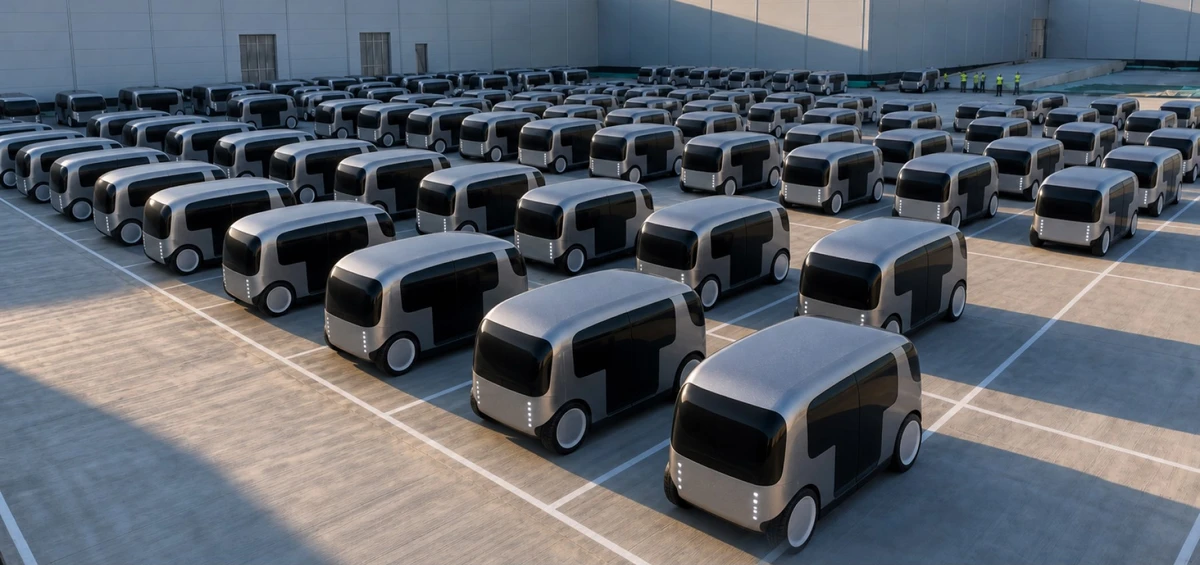

Robotaxis and autonomous vehicles have the potential to transform how cities move, help reduce accidents, ease congestion, and expand mobility access to those who need it most.
Realizing that potential, however, demands not only engineering breakthroughs. It requires a multi-layered ecosystem spanning automakers, fleet and passenger management systems, policymakers, and even regional authorities, all moving together to create scalable and practical autonomous mobility as a service, or MaaS.
What does MaaS mean?
Mobility as a Service, or MaaS, is a model in which transportation is delivered as a service rather than through privately owned vehicles, available on demand or on schedule wherever needed. The robotaxi is one of its most visible expressions, a self-driving vehicle you order through an app that arrives without a driver and navigates autonomously using a combination of sensors, mapping technology, and AI.
They span a range of use cases from complementing the traditional human-driven shared mobility to enabling ride shares across a city, but the underlying idea is the same across all of them. They are all driverless, on-demand or scheduled, and delivered as a service rather than a privately owned vehicle.
Why does technology form only a part of MaaS?
Even a small autonomous pilot reveals how many players are key. Take Mobileye’s autonomous pilot shuttle that operated in the Grorud Valley in Oslo, connecting suburban residents to major transit hubs. Behind that single service were a vehicle manufacturer, the Norwegian transit authority Ruter, and a mobility management provider, Holo, which handled the passenger-facing interface and fleet operations.
Add the regulators who approved the routes and the municipal authorities who enabled the pilot, and you have a full-fledged ecosystem of players involved in putting these vehicles on the road and connecting passengers from A to B.
Now imagine scaling that to a city. Or a region. Or multiple countries. At that level, the key players typically include:
• OEMs supply vehicles designed to support large-scale autonomous deployment
• Technology providers deliver the core autonomous driving stack, covering perception, decision-making, mapping, and safety architecture
• Fleet operators manage day-to-day vehicle availability, maintenance, and logistics
• Mobility platforms connect vehicles to passengers and integrate with broader transport networks
• Regulators and government authorities set the legal frameworks and approve operational zones at both the national and municipal level
No single entity owns all of these layers. Scaling robotaxis means getting all of them to work together, and working with a partner that can cut across multiple industries is often critical to viable deployment.
What is the technology needed to scale MaaS AV?
For an AV technology platform to function across this ecosystem, it has to be agnostic, or compatible with multiple vehicle types, adaptable to different operational models, and capable of powering everything from compact robotaxis to shuttles, buses, and delivery vehicles.
This is the design philosophy behind Mobileye's autonomous driving platform Mobileye Drive™. The idea is to use a shared core technology across different vehicle types and mobility programs, so development costs can be spread across broader deployment volumes, helping make autonomous driving more commercially scalable.
The technical foundation includes purpose-built AI models, sensor and algorithmic redundancy, and Mobileye REM™, a crowdsourced mapping layer that is designed to continuously update road data at scale.
Underpinning it all are two key safety frameworks: RSS (Responsibility-Sensitive Safety), a formally defined model that gives both industry and regulators a common language for what safe autonomous driving actually means, and PGF (Primary-Guardian-Fallback), a fusion architecture where an independent Guardian layer applies structured safety logic to monitor and validate every driving decision.
In a regulatory environment that varies significantly by region, that kind of shared framework isn't just useful, it's essential.
Scale requires more than coordination, it requires trust
Perhaps the most underestimated challenge in robotaxi deployment is public acceptance. Autonomous vehicles operate in public space, and the communities they serve have to trust them, not just technically, but institutionally. That trust is built through transparency, demonstrated safety, and meaningful engagement with regulators, local authorities, and transit agencies who understand their communities' needs.
There is no single global model for how this works. Regulatory environments differ. Urban layouts differ, as do passenger expectations. What works in one city may not translate directly to another. Successful scaling requires technology and operational frameworks flexible enough to adapt, while maintaining consistent safety standards across every environment.
The road ahead
Success in MaaS deployment means working with a provider that understands the full ecosystem, not just the autonomous driving technology, but the vehicle integration, fleet operations, rider experience, and regulatory engagement required to scale it.
That expertise can take different forms depending on what a given market needs. Sometimes it means vertical integration, owning the software, hardware, and sometimes even vehicle production end to end. Other times it means plugging into an existing ecosystem, working alongside OEMs, fleet operators, and mobility platforms that already bring their own capabilities.
Either way, autonomous driving technology is only one piece of the MaaS and robotaxi puzzle.
Mobileye is building toward both ends of that range. With our recently announced vertically integrated robotaxi initiative, Mobileye aims to deliver a single, packaged offering spanning autonomous driving, fleet operations, rider services, and mobility management for a partner who wants an integrated solution, while continuing to deliver core technology and operational expertise to those combining Mobileye's stack with their own capabilities elsewhere in the ecosystem.


