
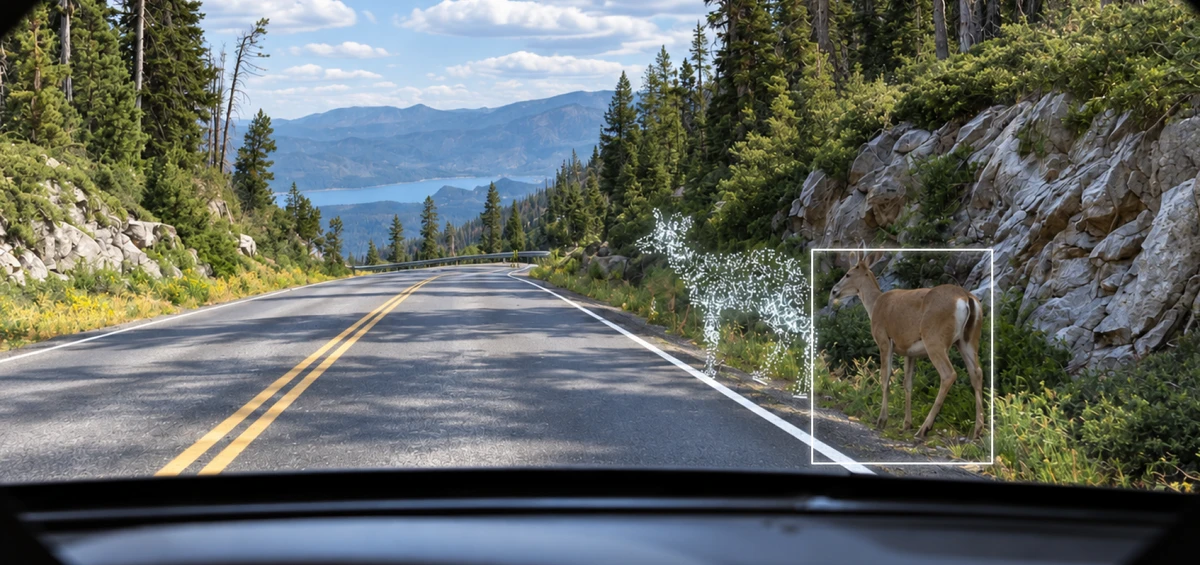

Wildlife collisions remain a significant road safety challenge worldwide. Animals can enter the roadway suddenly, move unpredictably, and leave drivers with little time to react. As advanced driver assistance systems (ADAS) and autonomous driving technologies continue to develop, animal detection remains an important area of focus. Supporting this capability requires systems to handle rare encounters, extreme animal diversity, and motion that is anything but linear.
According to a 2021 review published in Biological Conservation, more than one million ungulate-vehicle collisions are estimated to occur annually across Europe. In the United States, approximately 1.5 to 2.1 million deer-vehicle collisions occur annually, resulting in up to 440 human fatalities, 26,000 to 59,000 injuries, and more than $10 billion in property damage according to a 2025 paper in Global Ecology and Conservation.
Why animals are difficult to predict
Animal encounters are relatively rare in everyday driving. When they do happen, the animal may appear suddenly, be partially obscured, or become visible only after the available reaction time has already shrunk. Higher speeds make that window even smaller.
This makes it difficult to collect consistent training data from ordinary driving, and deliberately staging encounters can put motorists and animals at risk. The engineering problem is therefore not only “recognize an animal in a clear frame.” It is how to build robust detection and tracking when the examples that matter most are infrequent, visually varied, and often incomplete.
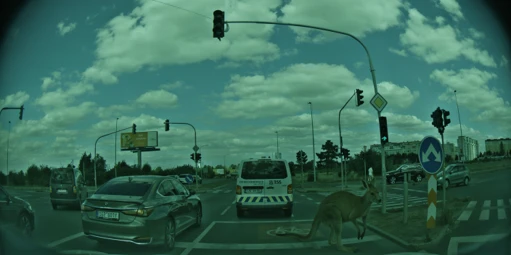
Unlike vehicles and the more familiar motion of pedestrians, animals often move in ways that are neither linear nor easily predictable. The kangaroo is a clear case: it doesn’t walk, and by hopping, it creates a distinctive motion pattern that animal-detection systems must learn to interpret.
To advance animal detection, Mobileye trains deep learning models on large and diverse datasets containing tens of thousands of images across dozens of animal classes, with variation in lighting, viewing angles, trajectories, poses, and movement patterns, while also accounting for things like size, shape, positions, motion,and significant diversity within the animal category itself. A horse, for example moves differently from a cow.
Taking all these factors into account helps the models learn a broad range of cues that can contribute to detection.
In India, for example, Mobileye extensively trained its algorithms to identify cows across diverse poses, viewing angles, and positions on or near the roadway, using front-facing camera input.
Complementing real-world data
To broaden the data pool, AI-generated data is used during training to complement real-world data. For example, developers can place different animal species within highway scenes, exposing the model to rare or unusual situations that may be difficult to capture at scale in the real world.
That mixture expands scenario and species coverage; it does not replace the need for real driving data or careful validation.
Tracking motion
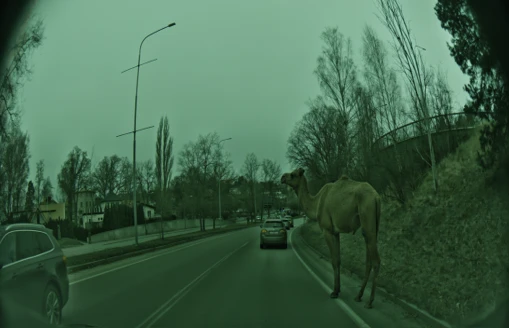
In addition to AI-generated training data, the models analyze information across previous frames to help anticipate how an animal may move. By tracking changes in position, trajectory, and motion over time, the system is designed to estimate where an animal may move next.
For example, the sudden movement of a deer toward the roadway creates motion patterns that can help the system assess how the situation is developing.
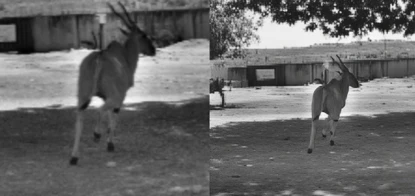
Detecting animals of different sizes and at different distances also requires visual information at multiple scales. To capture both fine visual detail and the broader scene, Mobileye’s animal detection model processes two resolutions of the same camera image in parallel before combining the visual information and processing it further.
The high-resolution input preserves fine visual details that can help identify small, distant, or partially occluded animals, while the lower-resolution input efficiently captures broader information about the surrounding scene.
Between the sheer diversity of animals in the real world, the dual-resolution processing needed to help detect small or distant animals, and the AI-generated scenarios used to expand training coverage, there is a lot of processing behind every detection.
Mobileye's EyeQ™6H SoC (system-on-chip) is designed for efficient, low-power processing intended to support this workload in real time.
Looking ahead
Animals are not going to start behaving predictably for the sake of a camera. What can improve is the engineering stack around them: broader and more careful training coverage, motion-aware tracking, multi-scale vision, and hardware that can sustain the work in the vehicle.
Diverse data, AI-generated scenarios used as a complement to real driving, temporal analysis, and regional adaptation are part of how Mobileye continues to advance animal detection, ongoing development work on a challenge that remains inherently unpredictable.


